
Motorcycle Registration 2026
Registration, Renewal, OR/CR, MVUC, Appointments, Fees & Services
LTO Motorcycle Registration in the Philippines
Complete LTO Registration Guide
Motorcycle registration in the Philippines is a mandatory legal requirement under the regulatory authority of the Land Transportation Office (LTO).
No motorcycle — whether privately owned, commercially operated, used for delivery services, or registered as a tricycle — may legally operate on public roads without valid registration.
Registration establishes legal ownership, confirms tax compliance through the Motor Vehicle User’s Charge (MVUC), enforces environmental standards, and enables law enforcement traceability.
Because motorcycles represent a significant portion of road users in the Philippines, compliance errors are common.
This authority guide explains every major aspect of motorcycle registration, including documentation, fees, renewal schedules, transfer of ownership, insurance requirements, emission testing obligations, and enforcement risks.
/motorcycle-or-and-cr/🔍 Quick Navigation – Motorcycle registration in the Philippines
- Motorcycle Registration Requirements – Required documents & compliance rules
- Motorcycle Registration Renewal – Plate schedule & step-by-step process
- Motorcycle Registration Fees & MVUC Rates – Fee breakdown & cost tables explained
- Transfer of Ownership for Motorcycle – Deed of sale & legal liability
- Late Registration Penalties – Surcharge rules & impound risks
- Motorcycle OR and CR Explained – Ownership & document compliance
- New Motorcycle Registration – Dealer processing & first renewal rules
- Motorcycle Plate Rules – Temporary plate format & enforcement standards
- Motorcycle Emission Testing & CTPL – Insurance & environmental compliance
- Motorcycle Registration Violations – Fines & administrative penalties
- Motorcycle Registration Checklist (PDF) – Downloadable preparation guide
Understanding Motorcycle Registration
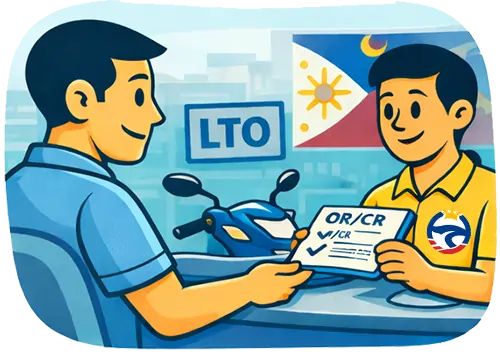 Motorcycle registration creates the official legal identity of a motorcycle within the LTO database. It links the engine number and chassis number to a registered owner and assigns a unique plate number. Registration is not only a payment transaction but a compliance mechanism that supports enforcement, liability determination, insurance validation, and environmental oversight. Understanding how registration functions structurally helps riders avoid documentation errors and compliance risks.
Motorcycle registration consists of several integrated compliance elements:
-
Official Receipt (OR) as Proof of Payment
The OR confirms that registration fees and MVUC have been paid for the applicable period. It indicates payment date, amount, and validity cycle. During roadside inspections, failure to present a valid OR may result in citation. The OR does not establish ownership but confirms current payment compliance.
-
Certificate of Registration (CR) as Proof of Ownership
The CR contains the registered owner’s name, engine number, chassis number, plate number, and vehicle classification. This document is required for ownership transfer, insurance claims, financing verification, and enforcement validation. Any mismatch in identification numbers may trigger administrative correction procedures.
-
Plate Number Assignment and Scheduling
Each motorcycle receives a unique plate number that determines the assigned annual renewal month. The last digit of the plate governs renewal scheduling under the LTO’s structured calendar system.
-
Motor Vehicle User’s Charge (MVUC) Compliance
MVUC is assessed annually and varies according to engine displacement. Accurate classification ensures proper fee computation and prevents renewal rejection.
-
Insurance and Environmental Verification
Valid CTPL insurance and emission testing are mandatory prerequisites for renewal approval.
Motorcycle registration is not merely administrative. It establishes enforceable legal accountability. Non-compliance exposes owners to fines, surcharge penalties, and potential impoundment. The registration framework ensures traceability, tax compliance, and safety oversight across millions of motorcycle units nationwide.
Motorcycle Registration Requirements
Motorcycle registration requires submission of specific documentation and completion of mandatory compliance steps before approval. Requirements differ slightly depending on whether the transaction involves new registration, annual renewal, or ownership transfer. Accuracy in documentation is critical because engine and chassis mismatches are among the most common causes of registration delay.
Core registration requirements include:
-
- Original Official Receipt (OR) and Certificate of Registration (CR)
These documents confirm payment status and ownership. The CR must accurately reflect engine and chassis numbers. Any discrepancy between physical markings and documentation may require correction before processing. - Valid Compulsory Third-Party Liability (CTPL) Insurance
CTPL insurance must be issued by an LTO-accredited provider. The policy must match the motorcycle’s plate number and engine details precisely. Without valid CTPL, renewal will not be processed. - Emission Test Certificate from Accredited Center
Environmental compliance must be verified through an accredited Private Emission Testing Center (PETC). A failed emission test requires mechanical repair and retesting before renewal approval. - Correct MVUC and Registration Fee Payment
Fees must correspond to the appropriate engine displacement category. Underpayment due to incorrect classification results in processing delays. - Valid Government-Issued Identification
Identification ensures correct encoding of ownership details in the LTO database. - Authorization Letter (if processed by representative)
If another person processes the transaction, formal authorization must be presented.
- Original Official Receipt (OR) and Certificate of Registration (CR)
Preparing documentation before visiting the LTO significantly reduces waiting time and prevents administrative rejection. Proper compliance ensures uninterrupted legal motorcycle operation and accurate database records.
👉 Detailed Guide: Motorbike Registration Requirements
Motorcycle Registration Fees & MVUC Rates by Engine Size
Motorcycle registration fees are primarily determined by engine displacement classification. The 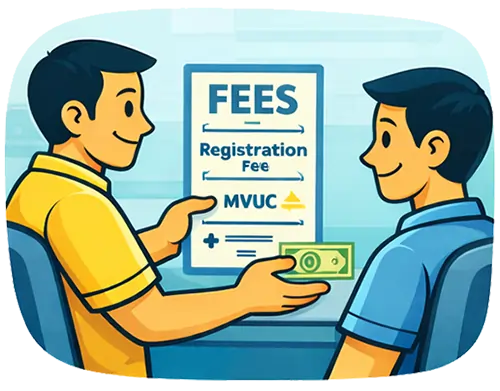 Motor Vehicle User’s Charge (MVUC) is assessed annually and increases progressively across engine brackets. Understanding how displacement categories affect annual costs allows riders to budget properly and avoid processing delays caused by incorrect fee computation. Registration costs are not limited to MVUC; administrative and system fees also apply. Accurate classification ensures proper payment and prevents renewal rejection due to underpayment or miscalculated brackets.
-
- Engine Displacement Classification Structure
Motorcycles are categorized into engine brackets such as 100cc and below, 101cc–150cc, 151cc–200cc, 201cc–400cc, and above 400cc. Each category carries a distinct MVUC rate. Larger displacement units incur higher annual road-use charges under regulatory classification guidelines. - Motor Vehicle User’s Charge (MVUC) Component
MVUC represents the primary annual cost of motorcycle registration. It is calculated based on engine size and functions as a statutory road-use contribution. Incorrect displacement classification during payment may delay processing and require recalculation before approval. - Administrative Registration Fee
Apart from MVUC, a standard annual registration fee applies to all motorcycles regardless of displacement. This administrative charge supports processing and regulatory record maintenance within the LTO database system. - Computer and System Processing Fees
Registration transactions include system encoding fees covering database management, transaction recording, and electronic verification. These charges are fixed administrative components applied during renewal or new registration. - Plate Issuance or Replacement Charges
When a motorcycle is newly registered or requires replacement plates due to loss or damage, additional plate-related fees may apply. These charges are separate from MVUC and standard administrative renewal costs.
- Engine Displacement Classification Structure
Understanding total fee composition ensures riders prepare accurate payment amounts before visiting the LTO branch. Proper budgeting prevents incomplete transactions and reduces the risk of repeat visits due to fee discrepancies.
👉 Full details on Motorbike Registration Fees
Motorcycle Registration Renewal & Plate Schedule
Motorcycle renewal follows a structured plate-number-based schedule. The last digit of the plate number determines the assigned renewal month, and weekly subdivisions may apply within that month. Failure to renew within the designated timeframe results in surcharge penalties and increases the likelihood of citation during roadside inspections or checkpoint operations.
-
- Plate-Number-Based Monthly Assignment
The final digit of the motorcycle’s plate number determines its renewal month. This system distributes annual processing volume evenly across the calendar year and standardizes compliance timelines nationwide. - Weekly Subdivision Within Assigned Month
In some cases, renewal may be further divided into weekly schedules based on the second-to-last digit. Riders should confirm their exact renewal window to avoid unnecessary delay or surcharge. - Emission Testing Requirement Before Renewal
An updated emission test certificate must be secured before visiting the LTO. A failed test requires mechanical repair and retesting before renewal approval can proceed. - Active CTPL Insurance Verification
CTPL insurance must be valid and correctly encoded at the time of renewal processing. Expired or mismatched insurance policies prevent transaction completion. - Surcharge for Late Renewal
Late renewal may result in a surcharge ranging from 25% to 50% of MVUC depending on the length of delay. Extended delays increase financial penalties and enforcement exposure.
- Plate-Number-Based Monthly Assignment
Timely renewal ensures uninterrupted legal operation and prevents unnecessary surcharge accumulation. Monitoring plate-digit schedules protects riders from avoidable enforcement risks and financial penalties.
👉 Step-by-step Fuide: Motorbike Rgistration Renewal
Transfer of Motorcycle Ownership
 Motorcycle ownership transfer must be processed immediately after sale to protect both buyer and seller from legal exposure. Until the LTO database reflects the new owner, the previous registered owner remains legally responsible for traffic violations, penalties, and potential civil liabilities. Proper documentation and prompt encoding are essential for legal clarity and future renewal processing.
-
- Notarized Deed of Sale Requirement
A notarized Deed of Sale serves as formal legal proof of the ownership transaction between buyer and seller. Without notarization, the document may be rejected during LTO processing. The notarized deed protects both parties by establishing a legally recognized transfer agreement. - Submission of Original OR and CR
The Official Receipt and Certificate of Registration must be presented during the transfer transaction. These documents confirm payment history and ownership status. The LTO verifies engine and chassis numbers against database records before approving any ownership update. - Emission Test Under Buyer’s Name
Prior to transfer approval, a valid emission test certificate must be secured under the buyer’s name. This ensures environmental compliance is associated with the new owner. A certificate issued under the seller’s name may not be accepted for ownership encoding. - CTPL Insurance Under Buyer’s Name
Compulsory Third-Party Liability insurance must reflect the buyer as the insured party. Insurance records must match the motorcycle’s plate and engine details. Without updated CTPL coverage, the LTO will not finalize database ownership transfer. - Immediate Encoding of New Ownership Record
Once documentation is verified and fees are paid, the LTO updates the registration database to reflect the buyer as the official registered owner. This update transfers legal responsibility and prevents future liability disputes involving the previous owner.
- Notarized Deed of Sale Requirement
Prompt ownership transfer eliminates legal ambiguity and protects both parties from future enforcement or liability complications.
👉 Check our full Motorbike Transfer Guide
Emission Testing & CTPL Insurance Compliance
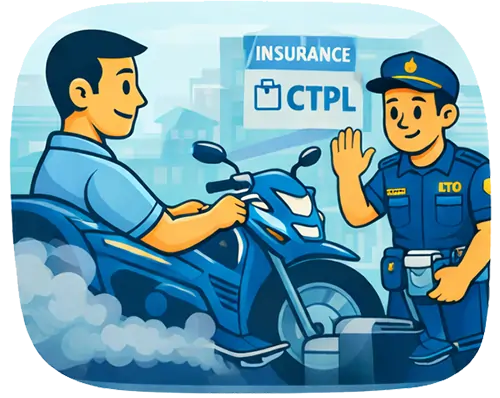 Emission testing and CTPL insurance are mandatory components of motorcycle registration approval. These requirements are embedded in the renewal and transfer process and must be satisfied before the LTO will authorize continued registration validity. Completing both requirements in advance reduces processing delays and administrative rejection.
-
- Accredited Emission Testing Center Requirement
Emission testing must be conducted at an LTO-accredited Private Emission Testing Center. Certificates issued by non-accredited facilities are invalid for registration purposes. Riders should verify accreditation status before testing to avoid wasted time and additional retesting costs. - Compliance With Environmental Standards
Motorcycles must meet established emission thresholds. If a unit fails testing, necessary mechanical repairs must be completed before a retest is conducted. Only a passing emission certificate allows renewal or transfer processing to proceed. - Mandatory CTPL Insurance Coverage
Compulsory Third-Party Liability insurance is required for all motorcycles, regardless of engine displacement. This insurance provides legally mandated coverage for injury claims involving third parties and must be active before registration approval. - Accurate Matching of Vehicle Details
CTPL policy information must match the motorcycle’s plate number, engine number, and classification. Discrepancies between insurance records and LTO database entries may delay or prevent transaction approval. - Validity Period Alignment With Registration Cycle
Insurance coverage and emission certification must remain valid at the time of registration processing. Expired policies or certificates cannot be used to complete renewal or transfer transactions.
- Accredited Emission Testing Center Requirement
Proper sequencing of emission testing and insurance procurement ensures smoother processing and reduces the risk of repeat visits to the LTO branch.
👉 Emission & CTPL details: /motorcycle-emission-ctpl/
Common Motorcycle Registration Violations & Penalties
Motorcycle registration violations may result in fines, surcharge penalties, or impoundment. Enforcement commonly occurs during roadside inspections, traffic stops, and checkpoint operations. Many violations stem from missed renewal schedules, improper documentation handling, or delayed ownership transfer.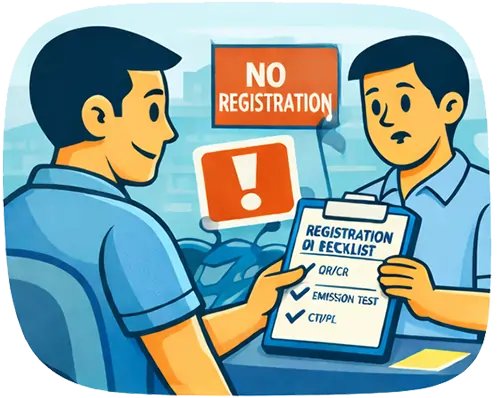
-
- Expired Registration Operation
Operating a motorcycle with expired registration may result in citation and financial penalties. Depending on the duration of delay, surcharge percentages may apply to the outstanding MVUC amount before renewal can be processed. - Failure to Present OR and CR During Inspection
Riders who cannot present valid Official Receipt and Certificate of Registration during inspection may receive citation. Even if registration is encoded in the system, physical document presentation is typically required during roadside verification. - No Valid CTPL Insurance Coverage
Operating without valid CTPL insurance violates mandatory insurance regulations. Expired or invalid coverage prevents renewal processing and may expose the rider to enforcement penalties during inspections. - Improper or Unauthorized Plate Display
Temporary or improvised plates that do not follow official format guidelines may result in citation. Even during plate release delays, riders must comply with authorized temporary plate standards. - Failure to Complete Ownership Transfer
Delayed transfer of ownership leaves the previous registered owner legally exposed to traffic violations and potential liabilities. Prompt transfer processing eliminates disputes and ensures accurate legal responsibility.
- Expired Registration Operation
Consistent compliance with registration rules significantly reduces enforcement risk and protects motorcycle owners from avoidable administrative and financial consequences.
👉 Learn all about Registration Violations.
🔍 People Also Ask
❓ Can I renew my registration before my assigned month?
Yes. Early renewal is generally allowed within LTO-approved windows before your plate’s assigned month. Late renewal, however, results in penalties.
👉 Learn more: How to Renew LTO Motorbike Registration
❓ Is CTPL insurance required every year for registration?
Yes. Valid Compulsory Third-Party Liability (CTPL) insurance is mandatory before the LTO will process your motorbike registration renewal.
👉 Full Guide: Emission Testing & CTPL Insurance Guide
❓ What happens if I drive with expired motorbike registration?
Driving with expired registration may result in fines, accumulated penalties, and possible motorbike impoundment during traffic apprehensions.
👉 Read more: Late Registration Penalties & Fines
❓ Can someone else process my LTO registration for me?
Yes. An authorized representative may process registration on your behalf, provided complete documents and authorization are submitted.
👉 Learn more: Motorbike Registration Requirements
Motorbike Registration FAQs
Is motorcycle registration required annually?
Yes. Motorcycle registration must be renewed every year based on the assigned plate schedule.
Does engine displacement affect fees?
Yes. MVUC rates increase according to engine displacement classification.
Can renewal be processed by a representative?
Yes, with proper authorization and required documentation.
Is CTPL mandatory for all motorcycles?
Yes. CTPL insurance is required for registration approval regardless of engine size.
What if I lose my OR or CR?
You must apply for duplicate documents at LTO to avoid processing delays and legal issues.
Final Thought
Motorbike registration in the Philippines is a structured compliance system that integrates ownership verification, annual taxation through MVUC, mandatory insurance coverage, and environmental standards. Understanding how these components interact prevents administrative delays, surcharge penalties, and enforcement complications.
Whether renewing, transferring ownership, or registering a new motorcycle, compliance depends on proper documentation, correct fee classification, and adherence to plate-based scheduling.
Riders who treat registration as a yearly legal obligation rather than a last-minute task significantly reduce financial risk and operational disruption. Consistent preparation ensures uninterrupted road legality and long-term regulatory stability.