
Motorcycle Registration Fees & MVUC
Registration Fees, MVUC Rates, Renewal Cost, Sample Calculation
Motorcycle Registration Fees & MVUC Rates
(Complete Cost Guide 2026)
Motorcycle registration fees in the Philippines are often misunderstood, especially regarding how costs are calculated. Unlike cars, motorcycle registration does not significantly scale with engine displacement. Instead, the Motor Vehicle User’s Charge (MVUC) follows a largely flat structure, while total costs vary due to insurance, emission testing, and administrative fees. Understanding the real fee breakdown helps riders avoid misinformation, budget accurately, and complete renewal without delays.
Motorcycle MVUC Rates (Official LTO Structure)
 Motorcycle MVUC rates are defined under existing LTO regulations and remain largely unchanged. Contrary to common belief, these charges do not significantly increase with engine size. Instead, motorcycles are grouped into simple categories based on configuration rather than displacement.
-
- Motorcycles Without Sidecar (Standard Category)
Standard motorcycles, regardless of engine size, are charged a flat MVUC rate of ₱240 annually. This applies to most privately owned motorcycles, including small commuter bikes and large displacement units, making MVUC consistent across categories. - Motorcycles With Sidecar (Tricycle Classification)
Motorcycles configured with a sidecar, commonly used as tricycles, are charged a slightly higher MVUC of ₱300 annually. This reflects their classification as public or utility transport vehicles with increased road usage. - MVUC Does Not Scale With Engine Size
Unlike cars, motorcycles do not have progressive MVUC tiers based on engine displacement. A 125cc motorcycle and a 1000cc motorcycle pay the same MVUC rate if both fall under the same classification category. - Legal Basis Under Road User’s Tax Framework
MVUC is implemented under national road-use taxation laws and is designed as a fixed contribution for motorcycles rather than a performance-based fee. This ensures predictable annual costs for all riders.
- Motorcycles Without Sidecar (Standard Category)
🔍 People Also Ask
❓ Does motorcycle MVUC depend on engine size?
No. MVUC is flat for motorcycles regardless of engine displacement.
👉 For your convenience: Motorcycle Registration Checklist
❓ Why do big bikes cost more to register?
Mainly due to insurance and additional costs, not MVUC.
👉 Learn more: New Motorbike Registration
❓ Is CTPL included in registration fees?
No. It is a separate mandatory cost like the Emission test.
Learn more: Motorcycle Emission & CTPL
❓ How much is motorcycle registration in the Philippines?
Typically ₱700 to ₱4,300 depending on type and expenses.
👉 All Info: Motorcycle Registration Philippines
Full Motorcycle Registration Fee Breakdown
Motorcycle registration costs go beyond MVUC and include several mandatory and administrative components. These fees collectively determine the total renewal amount and must be prepared before visiting the LTO.
-
- Motor Vehicle User’s Charge (MVUC)
MVUC remains the base fee and is fixed at ₱240 or ₱300 depending on classification. It represents the annual road-use tax required for legal operation. - Registration Fee (Administrative Charge)
A fixed registration fee, typically around ₱240, is applied to all motorcycles. This fee supports processing and regulatory administration within the LTO system. - Computer and Processing Fee
The computer fee, typically around ₱67.63, covers system encoding, transaction recording, and database maintenance during the renewal process. - Emission Testing Cost
Emission testing is required before renewal and typically costs between ₱300 and ₱500. This fee is paid directly to accredited testing centers and is separate from LTO charges. - CTPL Insurance Cost
CTPL insurance is mandatory and typically ranges from ₱300 to ₱600 depending on the provider. This cost contributes significantly to total renewal expenses.
- Motor Vehicle User’s Charge (MVUC)
Understanding each fee component ensures accurate budgeting and prevents incomplete payment issues during renewal transactions.
👉 Full Info about: Motorcycle Registration Renewal
Real Motorcycle Registration Cost Table (2026)
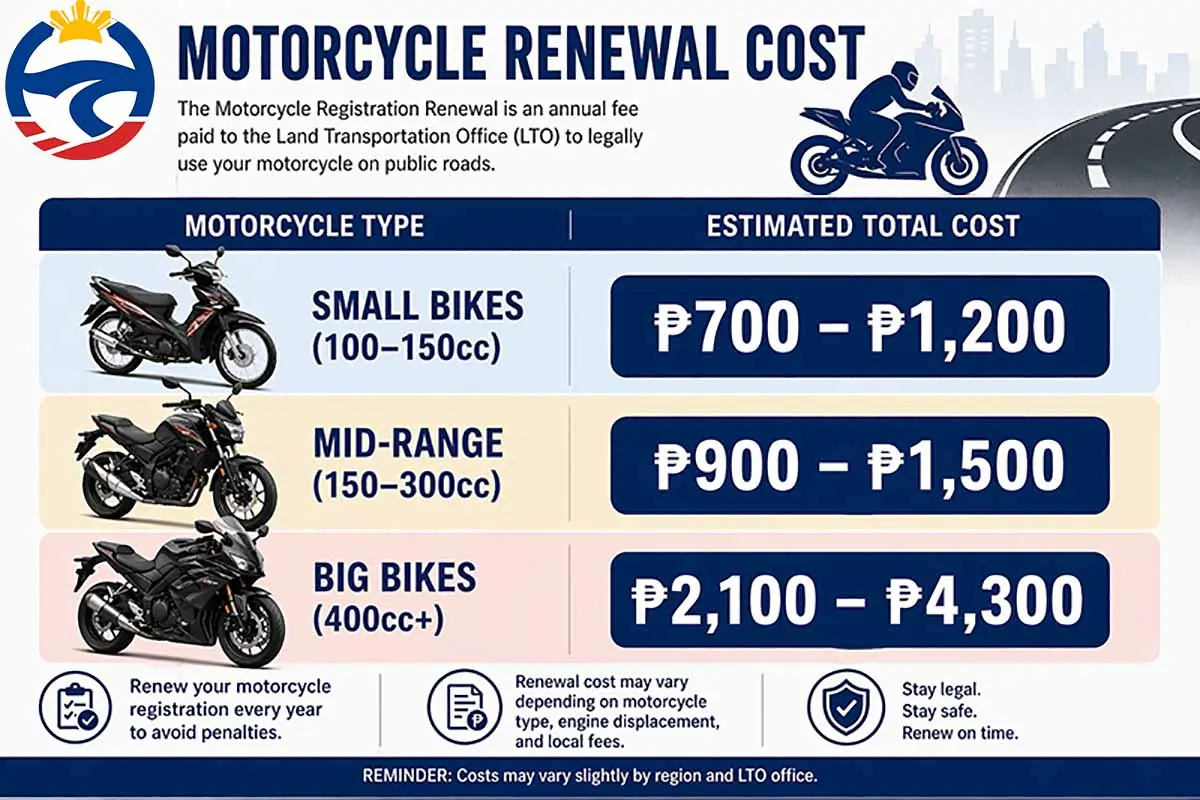
Below is a realistic overview of total motorcycle registration costs based on current LTO fee structures and typical compliance expenses.
| Motorcycle Type | Estimated Total Cost |
| Small (100–150cc) | ₱700 – ₱1,200 |
| Mid-range (150–300cc) | ₱900 – ₱1,500 |
| Big Bikes (400cc+) | ₱2,100 – ₱4,300 |
These estimates include MVUC, registration fees, emission testing, and CTPL insurance. Variations depend on insurance provider, location, and additional services required.
Why Big Bikes Still Cost More (Important Clarification)
Many riders assume that higher registration costs for big bikes are caused by MVUC increases. In reality, the difference comes from other cost factors rather than the base tax itself.
-
- Insurance Costs Increase With Vehicle Value
CTPL insurance and optional coverage may be priced higher for big bikes due to higher market value and perceived risk. - Optional Coverage and Add-Ons
Many big bike owners opt for additional insurance beyond CTPL, increasing total annual cost compared to smaller motorcycles. - Service and Compliance Preferences
Riders of larger motorcycles may use premium service providers, resulting in higher emission or administrative costs. - MVUC Remains Constant Across Categories
Regardless of engine size, MVUC remains the same within classification categories. This is the key distinction that many guides fail to explain.
- Insurance Costs Increase With Vehicle Value
Understanding this difference helps riders accurately interpret cost variations and avoid common misconceptions.
Additional Costs to Consider
Aside from standard registration fees, additional costs may arise depending on specific situations. These should be considered when preparing for renewal.
-
- Late Renewal Penalties
Surcharge penalties apply when registration is delayed, increasing total cost significantly depending on the length of delay. - Plate Replacement Fees
Lost or damaged plates require additional payment for replacement, separate from standard renewal costs. - Document Replacement Costs
Lost OR or CR requires affidavit and replacement fees before renewal can proceed. - Emission Retesting Fees
Failed emission tests require repairs and additional testing, increasing total cost. - Insurance Variability
CTPL pricing may vary between providers, affecting total renewal cost.
- Late Renewal Penalties
Accounting for these additional costs ensures more accurate financial preparation and prevents unexpected expenses.
Tips to Manage Motorcycle Registration Costs
While many fees are fixed, riders can still reduce unnecessary expenses through proper planning and maintenance.
-
- Renew On Time to Avoid Surcharge
Late penalties significantly increase costs. Timely renewal eliminates avoidable charges. - Maintain Motorcycle Condition
Well-maintained motorcycles are more likely to pass emission testing on the first attempt. - Choose Cost-Efficient Insurance Providers
Comparing CTPL providers may result in small but meaningful savings. - Prepare Documents in Advance
Avoid repeat visits and additional costs due to incomplete submissions. - Understand True Cost Structure
Recognizing that MVUC is fixed prevents budgeting errors and confusion.
- Renew On Time to Avoid Surcharge
Efficient planning ensures smoother renewal and reduces overall cost burden.
FAQs about the Registration Fees
What is MVUC?
The Motor Vehicle User’s Charge (MVUC) is an annual road-use tax required for all registered vehicles in the Philippines. For motorcycles, it is typically a fixed amount based on classification rather than engine size and must be paid during registration or renewal.
Do bigger motorcycles cost more to register?
Not because of MVUC. Motorcycle MVUC is generally the same regardless of engine size. However, total registration costs may be higher for bigger motorcycles due to higher insurance premiums and optional services, not because of the base tax itself.
Is emission testing included in LTO fees?
No. Emission testing is conducted at accredited testing centers and is paid separately from LTO registration fees. A valid emission certificate must be secured before renewal, and the cost typically depends on the testing facility.
Is CTPL included in MVUC?
No. CTPL insurance is a separate mandatory requirement and is not included in the MVUC or LTO registration fees. It must be purchased from an accredited provider before registration or renewal can be processed.
Final Thoughts
Motorcycle registration fees in the Philippines are often misunderstood, particularly regarding MVUC. While engine size significantly impacts registration costs for cars, motorcycles follow a largely flat MVUC structure.
The real variation in total cost comes from insurance pricing, optional services, and compliance-related expenses. Understanding this distinction allows riders to budget more accurately and prevents confusion during renewal. Proper cost awareness ensures smoother transactions and eliminates unexpected expenses at the LTO.