
Motorcycle Registration Requirements
Documents for renewal, transfer of ownership, new registration, emission testing, and CTPL
Motorbike Registration Requirements
(LTO Complete Guide 2026 Philippines)
Motorcycle registration in the Philippines requires complete documentation and compliance with multiple regulatory components before approval by the Land Transportation Office (LTO). Whether registering a new motorcycle, renewing an existing unit, or transferring ownership, requirements must be accurate and aligned with LTO records. Missing documents, expired certificates, or mismatched details are common causes of delays. This guide explains all required documents, insurance, emission testing, and special cases for smooth motorcycle registration processing.
🔍 People Also Ask
❓ What documents are required for motorcycle registration?
You need OR, CR, CTPL insurance, emission certificate, and valid ID.
👉 All Details: LTO Motorbike Regeistration Guide
❓ Is CTPL required for motorcycles?
Yes. CTPL insurance is mandatory for all motorcycle registrations.
👉 Read more: Motorcycle Emission Test
❓ Do motorcycles need emission testing every year?
Yes. Emission testing is required for annual renewal.
👉 All Info: Motorcycle Registration Renewal
❓ Can I register a motorcycle without CR?
No. The Certificate of Registration is required for most transactions.
👉 Additional Info: Motorcycle OR & CR
Documents Required for Motorcycle Registration
Motorbike registration begins with proper documentation that verifies ownership, payment history, and vehicle identity. All documents must match LTO records exactly, including engine and chassis numbers. Even minor inconsistencies may result in delays or additional verification steps. Preparing documents in advance ensures faster processing and reduces administrative complications during registration transactions.
- Official Receipt (OR) as Proof of Payment The Official Receipt confirms that registration fees and MVUC have been paid for the previous cycle. It contains payment details and transaction references. During renewal or inspection, the OR is used to verify that the motorcycle’s registration is current and properly settled.
- Certificate of Registration (CR) as Proof of Ownership The CR establishes legal ownership and includes the motorcycle’s plate number, engine number, chassis number, and classification. This document is required for renewal, transfer, and insurance processing. Any discrepancy must be corrected before approval.
- Valid Government-Issued Identification The registered owner must present valid identification to confirm identity and ensure accurate database encoding. IDs are required for both personal transactions and ownership verification during registration processing.
- Authorization Letter (if processed by representative) If another person processes the registration, a signed authorization letter must be submitted. Valid IDs of both the owner and representative are required to confirm legitimacy of the transaction.
- Additional Documents for Special Cases Certain transactions may require additional documents such as a Deed of Sale for ownership transfer or Affidavit of Loss for missing OR or CR. These documents support legal verification during processing.
Complete and accurate documentation ensures efficient processing and prevents repeat visits to the LTO branch.
CTPL Insurance Requirement for Motorcycles
Compulsory Third-Party Liability (CTPL) insurance is a mandatory requirement for all motorcycle registrations. It provides coverage for third-party injury or death resulting from accidents. Without valid CTPL insurance, the LTO will not process registration or renewal transactions.
- Mandatory for All Motorbikes
CTPL insurance applies to all motorcycles regardless of engine displacement or usage classification. It is a legal requirement before any registration transaction can be approved. - Must Be Issued by Accredited Providers
Only insurance policies issued by LTO-accredited providers are accepted. Policies from non-accredited companies are not valid for registration purposes. - Vehicle Details Must Match Policy
The insurance policy must reflect accurate plate number, engine number, and vehicle classification. Any mismatch may delay or prevent approval. - Annual Validity Requirement
CTPL insurance is typically valid for one year and must align with the motorcycle’s registration cycle. - Separate From Comprehensive Insurance
CTPL covers third-party injury only. Comprehensive insurance is optional and does not replace CTPL as a registration requirement.
Securing CTPL insurance before visiting the LTO ensures smoother processing and avoids unnecessary delays.
👉 Insurance guide: Motorbike CTPL
Emission Testing Requirement for Motorbikes
Emission testing ensures motorcycles meet environmental standards before registration approval. A valid emission test certificate is required during renewal and ownership transfer transactions.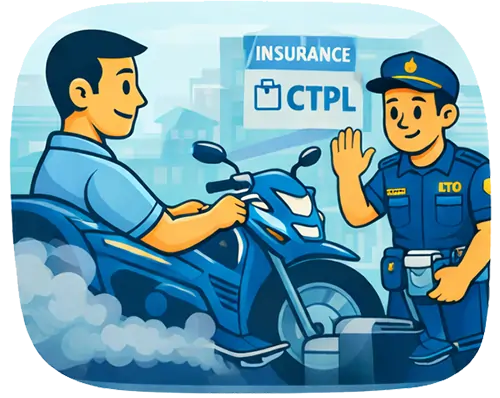
- Testing Must Be Done at Accredited Centers
Emission testing must be conducted at authorized Private Emission Testing Centers (PETCs). Certificates from unaccredited centers are not accepted. - Passing Certificate Required for Approval
Motorcycles must pass emission standards to receive a valid certificate. Failed tests require repair and retesting before processing can continue. - Certificate Must Be Valid During Processing
Expired emission certificates cannot be used for renewal. Timing the test correctly avoids repeat testing. - Required for Renewal and Transfer Transactions
Emission testing is mandatory during annual renewal and when transferring ownership to a new buyer. - Includes Vehicle Identification Verification
Testing includes checking engine and chassis numbers to ensure consistency with LTO records.
Completing emission testing in advance prevents delays and ensures smoother registration processing.
👉 More Info in our: Emission Testing Guide
Payment Requirements and Fees
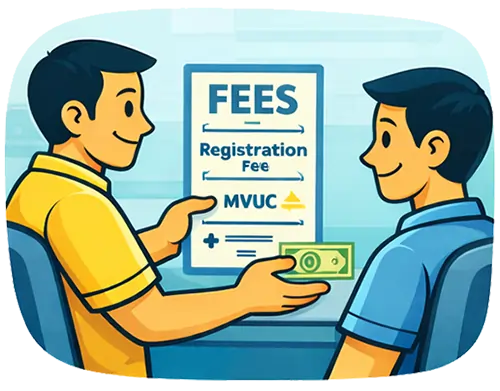 Motorbike registration requires payment of several fees, including MVUC and administrative charges. Understanding these costs ensures proper preparation before visiting the LTO branch.
-
- Motor Vehicle User’s Charge (MVUC)
MVUC is the primary annual fee and is based on engine displacement. Larger motorcycles incur higher charges. - Registration Fee
A standard administrative fee applied during renewal for all motorcycles. - Computer and Processing Fees
Covers system encoding and database processing within the LTO system. - Plate or Replacement Fees
Additional charges may apply for new registration or replacement plates. - Penalty Fees for Late Registration
Delayed renewal results in surcharge penalties depending on the length of delay.
- Motor Vehicle User’s Charge (MVUC)
Preparing correct payment prevents delays and ensures faster transaction processing.
👉 Fee breakdown: Motorcycle Registration Fees
Special Cases and Additional Requirements
Certain situations require additional documentation and verification before LTO approval. These cases involve more complex processing and may take longer to complete.
-
- Transfer of Ownership Cases
Requires notarized Deed of Sale, emission certificate under buyer’s name, and updated CTPL insurance. - Lost OR or CR Replacement
Requires Affidavit of Loss and payment of replacement fees before renewal. - Company-Owned Motorcycles
May require business registration documents and authorization letters. - Financed or Encumbered Motorcycles
Requires clearance or documentation from financing institutions. - Change of Classification or Use
Additional verification is required if the motorcycle is reclassified.
- Transfer of Ownership Cases
Understanding these requirements ensures proper preparation and prevents unexpected delays.
FAQs about the Registration Requirements
Can someone process registration for me?
Yes, with authorization letter and valid IDs.
Is CTPL required for all motorcycles?
Yes. It is mandatory regardless of engine size.
Is emission testing always required?
Yes, for renewal and most transfer cases.
What happens if documents don’t match?
Corrections must be made before approval.
Final Thoughts
Complete and accurate documentation remains the foundation of successful motorcycle registration. Ensuring that OR, CR, insurance, and emission certificates align with engine and plate details prevents processing rejection and database discrepancies.
Preparation before visiting the LTO branch reduces administrative delays and avoids repeat transactions. Compliance begins with documentation accuracy.