
LTO Car Registration Renewal
Renewal Schedule, Requirements, Fees, Penalties, Emission Testing
LTO Car Registration Renewal in the Philippines (Complete 2026 Guide)
LTO car registration renewal in the Philippines is required annually to keep your car legally authorized for public road use. Whether you own a private car, motorcycle, SUV, or commercial car, renewal must be completed according to the official schedule set by the Land Transportation Office (LTO).
Failure to renew on time can result in financial penalties, surcharge accumulation, and possible apprehension. This complete guide explains the renewal schedule, requirements, fees, penalty rules, and the exact step-by-step renewal process.
For a complete overview of the entire system, visit:
👉 LTO Car Registration Guide
Understanding the LTO Renewal Schedule
 LTO car registration renewal follows a structured plate-number-based schedule. The system distributes car owners evenly throughout the year to prevent congestion at LTO branches. Your assigned renewal month depends on the last digit of your plate number, while the specific week may be determined by the second-to-last digit.
Renewal month schedule:
-
- 1 → January
- 2 → February
- 3 → March
- 4 → April
- 5 → May
- 6 → June
- 7 → July
- 8 → August
- 9 → September
- 0 → October
Renewal must be completed within your assigned month to avoid penalties.
Understanding your plate schedule ensures you plan ahead and avoid unnecessary surcharges or compliance risks.
🔍 People Also Ask
❓ Can I renew before my assigned month?
Yes. Early renewal may be allowed, but penalties apply only if you renew late.
👉 Learn more: LTO Car Registration Guide
❓ Is emission testing required every year for renewal?
Yes. A valid emission test certificate is required before renewal processing.
👉 More Info: Emission Testing & CTPL Guide
❓ What happens if I drive with expired registration?
Driving with expired registration may result in fines, penalties, and possible impoundment.
👉 Read more: Late Registration Penalties
❓ Is CTPL insurance mandatory for renewal?
Yes. Valid CTPL insurance must be secured before LTO processes renewal.
👉 Learn more: Registration Requirements
LTO Car Registration Renewal Requirements
Before visiting the LTO branch, preparing complete renewal documents is essential. Missing even one requirement can delay processing or result in repeat visits. Ensuring accuracy and validity of each document significantly speeds up the renewal process.
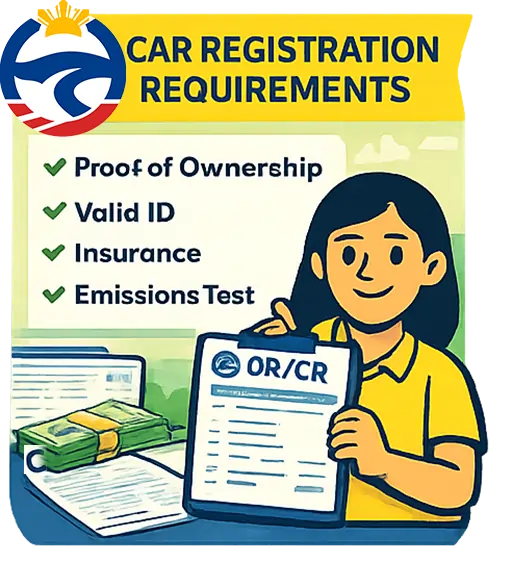
Standard renewal requirements include:
-
- Original Official Receipt (OR)
- Original Certificate of Registration (CR)
- Valid CTPL insurance (current coverage year)
- Valid emission test certificate
- Payment for MVUC and renewal fees
- Authorization letter (if representative processes renewal)
All documents must match car details exactly.
For a full breakdown of required documents and special cases, see:
👉 LTO Car Registration Requirements
Proper preparation allows most car registration renewals to be completed within the same day.
Step-by-Step Process for LTO Registration Renewal
Completing LTO car registration renewal requires following a specific order. Skipping steps or securing documents out of sequence can result in unnecessary delays. The process is straightforward when done correctly.
 Step 1: Complete Emission Testing
-
- Visit accredited Private Emission Testing Center (PETC)
- Bring car physically
- Secure emission certificate
Step 2: Secure CTPL Insurance
-
- Purchase valid Compulsory Third-Party Liability insurance
- Verify correct car details
Step 3: Visit LTO Branch
-
- Present OR and CR
- Submit emission certificate
- Submit CTPL insurance
Step 4: Pay Registration Fees
-
- Pay MVUC
- Pay registration fee
- Pay computer and sticker fees
Step 5: Receive Updated Official Receipt
-
- Secure updated OR
- Confirm new validity period
For cost estimates and tables, see:
👉 LTO Car Registration Fees & MVUC
Following this structured process ensures faster approval and prevents administrative rejection.
LTO Car Registration Renewal Fees
Renewal costs depend on car type, weight classification, and engine displacement. The Motor Car User’s Charge (MVUC) typically represents the largest portion of the payment. Understanding these components helps car owners estimate total renewal cost before visiting LTO.
Renewal fees typically include:
-
- MVUC
- Registration fee
- Computer fee
- Sticker fee
- Late penalty (if applicable)
Additional required expenses:
-
- Emission testing fee
- CTPL insurance premium
For complete fee tables and downloadable calculator, see:
👉 LTO Registration Fees Guide
Planning financially for renewal prevents delays caused by insufficient payment preparation.
Late Registration Renewal and Penalties
Missing your assigned renewal month results in financial penalties. The surcharge is based on the MVUC and increases depending on how long the registration remains expired. Delayed renewal also increases the risk of traffic apprehension.
Late renewal consequences may include:
- 25% surcharge of MVUC (short delay)
- 50% surcharge for extended delay
- Possible fines during checkpoint inspections
- Car impoundment in severe cases
The longer the delay, the higher the accumulated cost.
For complete penalty computation breakdown, visit:
👉 Late Registration Penalties
Renewing within your assigned schedule is always more cost-effective than settling accumulated surcharges.
Can You Complete Registration Renewal Online?
Many car owners wonder whether LTO car registration renewal can be completed entirely online. While the LTMS portal improves digital access, most renewal processes still require physical compliance due to emission testing and insurance verification requirements.
Through LTMS, you may:
-
- View registered cars
- Monitor transaction history
- Check digital records
However, physical document submission remains mandatory for most renewals.
For more information about LTMS functionality, see:
👉 LTMS Portal Guide
Digital tools enhance transparency but do not replace regulatory compliance procedures.
Common Mistakes That Delay Renewal
Even simple mistakes can delay LTO car registration renewal. Many car owners underestimate the importance of document accuracy and timing. Avoiding these common issues helps ensure smooth processing.
Common renewal mistakes include:
- Expired CTPL insurance
- Emission certificate outside validity window
- Missing original OR or CR
- Ignoring plate-number schedule
- Incorrect penalty calculation
Double-checking all documents before visiting LTO significantly reduces waiting time and repeat visits.
For full registration overview, return to:
👉 LTO Car Registration Guide
Preparation and compliance awareness are key to stress-free renewal.
FAQs about the Registration Renewal
How long does registration renewal take?
If documents are complete, renewal can typically be processed within the same day.
Can someone renew on my behalf?
Yes. An authorization letter and valid identification are required.
Is CTPL required for motorcycles?
Yes. CTPL insurance is mandatory for motorcycles and all motor cars.
Do I receive a new CR every year?
No. You usually receive an updated Official Receipt.
Can I renew at any LTO branch?
In most cases, yes, depending on transaction type and branch capacity.
Final Thought
Registration renewal must be completed within the assigned plate-based schedule to avoid surcharge penalties and enforcement risks.
Securing emission and CTPL insurance before visiting the LTO streamlines the process and reduces delays. Consistent monitoring of renewal timelines ensures uninterrupted legal operation and protects vehicle owners from avoidable financial penalties.