
Late Registration Penalties
Surcharge Rates, MVUC Penalties, Fines, Impoundment Risks, Overdue Fees
LTO Late Registration Penalties in the Philippines
LTO late registration penalties in the Philippines apply when a vehicle owner fails to renew registration within the assigned renewal schedule. The Land Transportation Office (LTO) imposes surcharge percentages based on the Motor Vehicle User’s Charge (MVUC), and additional enforcement penalties may apply if a vehicle is apprehended while expired. Understanding how penalties are computed and how to resolve overdue registration helps vehicle owners avoid escalating costs and legal risks.
When Does Vehicle Registration Become Late?
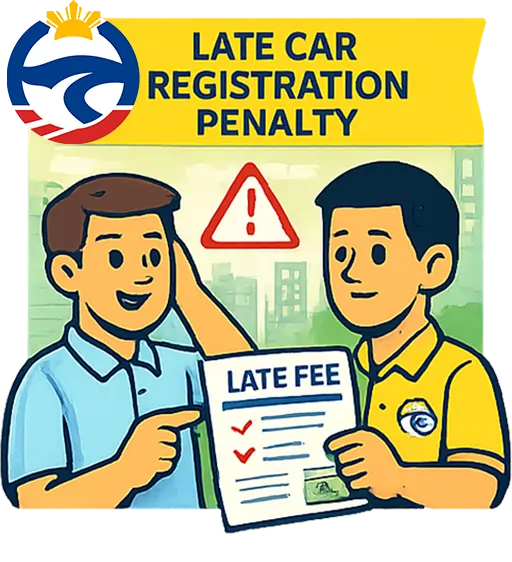 Vehicle registration becomes officially late once the assigned renewal month passes without completion of renewal.
The Philippines follows a strict plate-number-based system, and missing this window automatically activates surcharge rules. Even a short delay can trigger penalty computation under LTO guidelines.
Registration is considered late when:
-
- Renewal is not completed within assigned month
- MVUC remains unpaid after due schedule
- Vehicle operates on public roads while expired
- Required renewal documents are not submitted
The length of delay determines the applicable surcharge percentage.
Understanding exactly when registration becomes overdue allows vehicle owners to act quickly and prevent penalties from increasing unnecessarily.
🔍 People Also Ask
❓ How much is the LTO late registration penalty?
Penalties range from 25% to 50% of MVUC depending on the length of delay.
👉 Learn more: LTO Registration Fees
❓ Can my vehicle be impounded for expired registration?
Yes. Operating an unregistered vehicle may result in apprehension and impoundment.
👉 More Info: Registration Renewal Guide
❓ Is penalty applied to the full registration fee?
No. The Surcharge is applied only to the MVUC portion of the registration cost.
👉 Read more: Registration Fees and MVUC Guide
❓ Can I renew registration after one year of expiration?
Yes, but higher surcharges and additional penalties may apply.
👉 Learn more: How to Renew Registration
How LTO Late Registration Penalties Are Computed
LTO late registration penalties are calculated primarily using the Motor Vehicle User’s Charge (MVUC) as the base amount. The surcharge percentage increases depending on how long the registration remains expired. The longer the delay, the higher the accumulated penalty applied to the MVUC portion only.
Standard surcharge structure:
-
- Up to 1 month late → 25% of MVUC
- 2 to 12 months late → 50% of MVUC
- Beyond 1 year late → 50% of MVUC plus additional yearly surcharge
The surcharge applies only to MVUC, not to the entire registration fee.
For MVUC breakdown tables, see:
👉 LTO Vehicle Registration Fees
Knowing how the computation works helps vehicle owners estimate total payable amounts before visiting the LTO branch.
Example Penalty Computation Scenarios
Reviewing practical examples makes it easier to understand how penalties affect total registration costs. These estimates demonstrate how surcharge percentages increase overall payable amounts depending on the delay period and vehicle classification.
Example scenarios:
- Sedan (MVUC ₱2,000), 1 month late → ₱500 penalty (25%)
- SUV (MVUC ₱2,500), 6 months late → ₱1,250 penalty (50%)
- Motorcycle (MVUC ₱300), 1 year late → ₱150 penalty (50%)
These figures exclude emission testing and CTPL insurance costs.
Actual total payable will include renewal fees, emission testing, insurance premiums, and any administrative charges required during processing.
Additional Consequences Beyond Financial Penalties
Late registration penalties extend beyond surcharge payments. Operating an unregistered vehicle exposes owners to enforcement actions during traffic inspections and compliance checkpoints. Administrative consequences may increase total cost significantly.
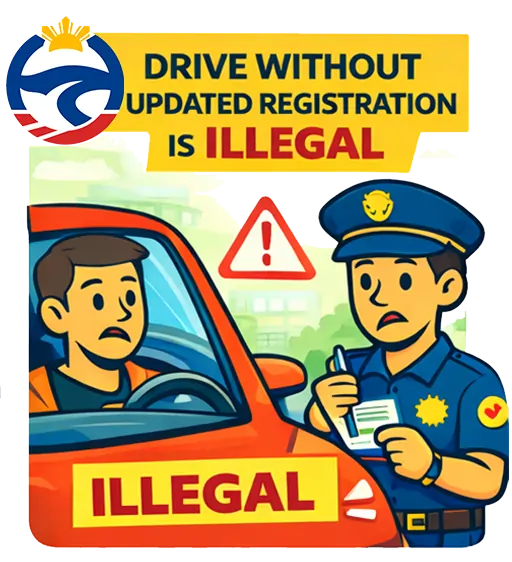 Possible consequences include:
- Traffic violation fines
- Vehicle impoundment
- Temporary confiscation of license plates
- Additional administrative processing fees
- Delays in ownership transfer
Enforcement severity may increase during nationwide operations. Avoiding operation of an expired vehicle reduces the risk of compounding financial and legal consequences.
How to Settle Expired Registration Properly
If your registration has already expired, settling it immediately prevents further penalty accumulation. The settlement process largely follows standard renewal procedures but includes payment of applicable surcharge percentages based on MVUC.
Steps to settle overdue registration:
- Complete emission testing
- Secure valid CTPL insurance
- Present original OR and CR
- Pay MVUC plus surcharge
- Pay registration and computer fees
For complete renewal walkthrough, see:
👉 LTO Registration Renewal Guide
Acting promptly limits financial exposure and prevents additional administrative enforcement actions.
Transfer of Ownership with Expired Registration
Vehicles with expired registration can still be transferred, but penalties and overdue renewal fees must be settled first. The LTO will not approve ownership transfer without clearing outstanding registration obligations.
In cases of expired registration:
-
- MVUC surcharge must be paid
- Renewal fees must be settled
- Emission testing required
- CTPL insurance required
- Transfer fee applied
Ownership transfer cannot proceed without resolving these obligations.
For complete transfer guide, see:
👉 Transfer of Ownership
Clearing overdue registration first ensures smoother ownership transfer and prevents rejection at processing counters.
Common Mistakes That Increase Penalty Costs
Many vehicle owners unintentionally increase their financial burden by misunderstanding how penalties are triggered and calculated. Avoiding common errors helps minimize accumulated surcharge and administrative complications.
Frequent mistakes include:
-
- Ignoring assigned renewal month
- Continuing to operate vehicle while expired
- Delaying renewal for multiple months
- Miscalculating surcharge percentages
- Failing to verify correct MVUC classification
Proactive monitoring of renewal schedules is the most effective way to prevent penalty escalation. Staying informed and organized significantly reduces risk of late registration penalties.
FAQs about Late Registration Penalties
Is there a grace period for renewal?
No official grace period applies once the assigned month has passed.
Does penalty increase monthly?
Penalty percentage increases based on delay duration brackets.
Can penalties be waived?
Penalty waivers are rare and require official LTO authorization.
Is emission testing required for overdue renewal?
Yes. Emission testing remains mandatory.
Can someone settle penalties for me?
Yes, with authorization and complete documents.
Final Thought
Late vehicle registration can result in surcharge penalties, additional administrative costs, and possible enforcement complications.
Addressing renewal delays immediately minimizes financial impact and reduces risk of citation during inspections. Staying within the assigned renewal period remains the most effective strategy for avoiding unnecessary penalties.