
Registration Fees & MVUC
MVUC, Renewal Fees, Motorcycle & Car Registration Costs
LTO Car Registration Fees & MVUC (Complete Cost Breakdown – Philippines)
Understanding LTO car registration fees in the Philippines is essential before renewing, transferring ownership, or registering a new car. Registration costs are not fixed — they vary depending on car type, weight classification, engine displacement, and usage category.
The largest portion of the cost is typically the Motor Vehicle User’s Charge (MVUC), a mandatory road usage tax. This guide provides a detailed breakdown of all fees involved, including renewal, transfer, duplicate documents, and late penalties.
For a full overview of the registration process, visit the main pillar:
👉 LTO Car Registration Guide
What Is MVUC (Motor Vehicle User’s Charge)?
The Motor Vehicle User’s Charge (MVUC) is a government-imposed road usage tax included in LTO car registration. It funds road maintenance and infrastructure projects across the Philippines.
MVUC is calculated based on:
- Car classification
- Gross car weight
- Engine displacement
- Private vs commercial use
Heavier cars and commercial units typically incur higher MVUC rates because of greater road impact.
MVUC is paid annually during registration renewal. Failure to pay results in incomplete registration and possible penalties.
For document requirements related to MVUC payment, see:
👉 LTO Car Registration Requirements
Understanding MVUC structure helps car owners anticipate total renewal cost.
🔍 People Also Ask
❓ How much is LTO car registration in the Philippines?
Registration costs vary depending on car type, weight, and MVUC classification. Private cars and motorcycles have different fee structures.
👉 Learn more: LTO Car Registration Guide
❓ What is included in MVUC payment?
MVUC is a mandatory road usage tax included in annual registration fees. It funds infrastructure and road maintenance.
👉 More Info: Car Registration Requirements
❓ Are motorcycle registration fees cheaper than cars?
Yes. Motorcycle registration fees are generally lower due to smaller engine displacement and weight classification.
👉 Learn more: Registration Renewal Guide
❓ How are the late penalties calculated?
Late penalties are computed monthly and depend on the LTO classification of your vehicle and the length of expiration.
👉 Read more: Late Registration Penalties
LTO Registration Fees for Private Cars
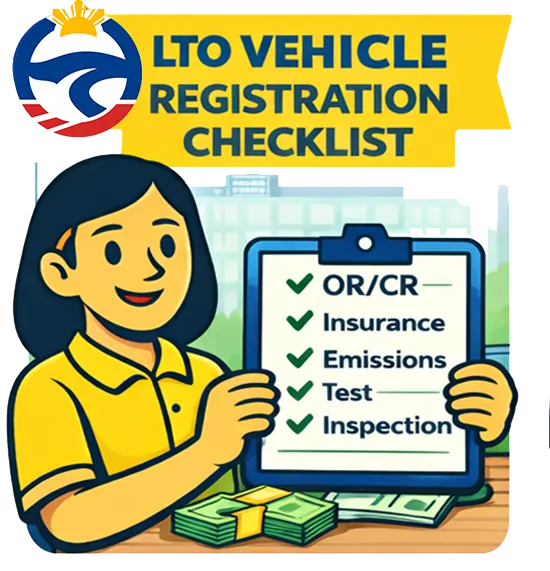 Private passenger cars are the most commonly registered cars in the Philippines. Registration costs depend largely on weight category and engine size.
Typical annual fees for private cars may include:
- MVUC (varies by weight class)
- Registration fee
- Computer fee
- Sticker fee
- Plate fee (if applicable)
As a general estimate, private car registration may range between several thousand pesos depending on classification.
Exact costs vary, so car owners should verify classification details listed on their Certificate of Registration (CR).
For a complete renewal walkthrough, see:
👉 How to Renew LTO Car Registration
Planning ahead financially prevents renewal delays.
Estimated LTO Car Registration Fees (Philippines 2026)
⚠️ Note: Fees may vary slightly depending on LTO branch, updated government rates, and car classification. Always verify final computation at your LTO office.
LTO Car Registration Renewal Fees
Renewal costs depend on car type, weight classification, and engine displacement. The Motor Car User’s Charge (MVUC) typically represents the largest portion of the payment. Understanding these components helps car owners estimate total renewal cost before visiting LTO.
Renewal fees typically include:
-
- MVUC
- Registration fee
- Computer fee
- Sticker fee
- Late penalty (if applicable)
Additional required expenses:
-
- Emission testing fee
- CTPL insurance premium
For complete fee tables and downloadable calculator, see:
👉 LTO Registration Fees Guide
Planning financially for renewal prevents delays caused by insufficient payment preparation.
Private Car Registration Fee Estimates
Private cars are classified mainly by gross car weight (GVW). MVUC increases with weight.
Estimated Annual Registration Cost – Private Cars
| Car Type | Estimated MVUC | Other Fees (Reg, Comp, Sticker) | Estimated Total Annual Cost |
| Sedan (≤ 1,600 kg) | ₱1,600 – ₱2,000 | ₱1,000 – ₱1,500 | ₱2,600 – ₱3,500 |
| SUV / MPV | ₱2,000 – ₱3,000 | ₱1,000 – ₱1,500 | ₱3,000 – ₱4,500 |
| Pickup / Van | ₱2,400 – ₱3,600 | ₱1,000 – ₱1,500 | ₱3,400 – ₱5,100 |
What’s included in “Other Fees”?
-
- Registration Fee
- Computer Fee
- Sticker Fee
- Legal Research Fee
👉 Full renewal process explained
Private car owners should also factor in CTPL insurance (typically ₱560–₱1,000 annually) and emission testing (around ₱500–₱700).
LTO Registration Fees for Motorcycles
Motorcycle registration fees are generally lower compared to four-wheel cars. However, MVUC still applies based on engine displacement.
Typical motorcycle registration costs may include:
- MVUC (based on CC rating)
- Registration fee
- Computer fee
- Sticker fee
Motorcycles with higher engine displacement may incur slightly higher MVUC charges. Motorcycle owners must still complete emission testing and secure CTPL insurance before renewal.
For insurance and emission requirements, see:
👉 Emission Testing & CTPL Insurance Guide
Understanding these components ensures smooth processing during renewal.
Motorcycle Registration Fee Estimates
Motorcycle MVUC depends primarily on engine displacement (CC).
Estimated Annual Registration Cost – Motorcycles
| Engine Size | Estimated MVUC | Other Fees | Estimated Total |
| 100cc – 150cc | ₱240 – ₱360 | ₱600 – ₱1,000 | ₱840 – ₱1,360 |
| 200cc – 400cc | ₱480 – ₱600 | ₱600 – ₱1,000 | ₱1,080 – ₱1,600 |
| 400cc+ | ₱600 – ₱1,000 | ₱600 – ₱1,000 | ₱1,200 – ₱2,000 |
Motorcycles still require:
-
- Emission testing
- CTPL insurance
- Original OR/CR
Motorcycle registration remains significantly more affordable than four-wheel cars.
Registration Fees for Commercial Cars
Commercial cars, including taxis, buses, delivery trucks, and TNVS units, incur higher registration fees due to their weight classification and usage impact.
Commercial car fees may include:
-
- Higher MVUC rate
- Franchise verification (if applicable)
- Registration fee
- Computer fee
- Emission testing fee
- Insurance compliance
Operators should ensure all permits are updated before renewal to prevent administrative rejection. Commercial operators should anticipate higher annual compliance costs.
Commercial Car Registration Estimates
Commercial cars are assessed based on gross car weight and usage category.
Estimated Annual Cost – Commercial Cars
| Car Type | Estimated MVUC | Other Fees | Other Fees |
| Taxi | ₱2,400 – ₱3,000 | ₱1,500 – ₱2,000 | ₱3,900 – ₱5,000 |
| Delivery Van | ₱3,000 – ₱4,000 | ₱1,500 – ₱2,000 | ₱4,500 – ₱6,000 |
| Light Truck | ₱4,000 – ₱6,000 | ₱1,500 – ₱2,500 | ₱5,500 – ₱8,500 |
| Heavy Truck | ₱6,000 – ₱10,000+ | ₱2,000+ | ₱8,000 – ₱12,000+ |
Commercial operators must also ensure:
-
- Franchise validity
- Business permits
- Higher insurance coverage
Commercial registration costs are higher due to increased road impact classification.
Transfer of Ownership Fees
 When buying or selling a car, transfer fees are added on top of renewal and MVUC costs.
Transfer-related charges may include:
-
- Transfer fee
- Change classification fee (if applicable)
- Emission testing under new owner
- Updated CTPL insurance
- Registration fee
These fees are mandatory for legal ownership transfer.
For a complete step-by-step legal guide, see:
👉 Transfer of Ownership Guide
Processing transfer promptly avoids future liability complications.
🔄 Transfer of Ownership Fee Estimates
When transferring ownership, additional charges apply beyond normal renewal fees.
Estimated Transfer Fees
| Fee Type | Estimated Cost |
| Transfer Fee | ₱100 – ₱200 |
| Change Classification Fee (if applicable) | ₱100 – ₱200 |
| Emission Testing | ₱500 – ₱700 |
| CTPL Insurance | ₱560 – ₱1,000 |
Total additional cost estimate: ➡ ₱1,200 – ₱2,000 (excluding renewal + MVUC)
Processing transfer immediately prevents future liability complications
Duplicate OR and CR Fees
If the Official Receipt (OR) or Certificate of Registration (CR) is lost or damaged, duplicate copies must be requested from LTO.
Replacement typically requires:
-
- Affidavit of loss
- Valid ID
- Payment of duplicate document fee
- Verification of car record
Fees for duplicate OR or CR are generally lower than renewal costs but still mandatory.
For full document recovery process, visit:
👉 OR and CR Guide
Prompt replacement prevents issues during renewal or checkpoint inspections.
Duplicate OR/CR Replacement Fees
If documents are lost, replacement fees apply.
| Document | Estimated Cost |
| Duplicate OR | ₱100 – ₱200 |
|
Duplicate CR |
₱100 – ₱200 |
|
Affidavit of Loss (Notary) |
₱150 – ₱500 |
👉 Replacement process guide:
Losing OR/CR may delay renewal or transfer processing.
Late Registration Penalty Computation
Driving with expired registration results in additional penalties. These accumulate monthly and vary by car type.
Late penalties may include:
- Monthly MVUC surcharge
- Additional administrative fees
- Fines imposed during apprehension
The longer the delay, the higher the total cost.
For detailed penalty computation breakdown, see:
👉 Late Registration Penalties & Fines
Renewing on time is always more affordable than settling overdue penalties.
Late Registration Penalty Estimates
Late renewal results in surcharge accumulation.
Estimated Penalty Structure
| Delay Period | Estimated Penalty Impact |
| 1 Month Late | 25% of MVUC |
| 2–12 Months Late | 50% of MVUC |
| Over 1 Year | 50% of MVUC + additional surcharge |
⚠️ Apprehension may also result in separate fines under traffic regulations.
Renewing on time is significantly more cost-effective.
Example Cost Scenarios
Example 1: Sedan Renewal (On Time)
- MVUC: ₱2,000
- Other LTO Fees: ₱1,200
- Emission Test: ₱600
- CTPL: ₱800
Estimated Total: ₱4,600
Example 2: Motorcycle (150cc) Renewal
- MVUC: ₱300
- LTO Fees: ₱800
- Emission: ₱600
- CTPL: ₱600
Estimated Total: ₱2,300
Example 3: SUV (2 Months Late)
- MVUC: ₱2,500
- Other Fees: ₱1,200
- Penalty (50% MVUC): ₱1,250
- Emission + CTPL: ₱1,400
Estimated Total: ₱6,350
Other Possible Registration Costs
In some situations, additional fees may apply beyond standard renewal charges.
These may include:
-
- Plate replacement fee
- Change of color fee
- Change engine fee
- Correction of records fee
- Mortgage annotation fee
Special cases require verification at LTO branches. Car owners should confirm all details listed in the CR to prevent unexpected administrative costs. Being aware of potential extra charges prevents financial surprises.
Why Fee Transparency Matters
Understanding LTO car registration fees helps car owners:
- Budget accurately
- Avoid penalty accumulation
- Prevent last-minute financial stress
- Compare private vs commercial costs
- Estimate total cost before LTO visit
For complete system overview, return to the main hub:
👉 Car Registration Hub
FAQs about the MVUC
Is MVUC paid every year?
Yes. MVUC must be paid annually during registration renewal.
Do new cars pay MVUC?
Yes. MVUC is included in initial registration processing.
Are commercial cars more expensive to register?
Yes. Commercial cars incur higher MVUC rates.
Is CTPL insurance included in LTO fees?
No. CTPL insurance is purchased separately before renewal.
Can I pay registration fees online?
Most payments are processed physically at LTO branches.
Final Thought
Vehicle registration fees are not limited to MVUC alone. Administrative charges, system fees, and possible plate-related costs all contribute to the total renewal amount.
Knowing your vehicle classification and displacement category allows for accurate budgeting and prevents underpayment delays. Clear understanding of the fee structure ensures smoother transactions and avoids unnecessary recalculation during processing.